

Razer Book 13 review: A slick laptop with a disappointing keyboard - fosterithen1937
The Razer Book 13 is a classic example of why you shouldn't judge a book past its cover.
This is a gorgeous laptop to behold—a keen-edged slab of aluminum with a 16:10 display, slim bezels, and a munificently-sorted trackpad. It has Intel's latest 11th-generation Heart C.P.U., front recognition, and not a retrace of pre-installed bloatware. At a glance, you might think it commands all centime of its interrogative toll.
And then you start writing on information technology, and the intact experience comes squishing down—on its mushy, imprecise, low-travel keyboard. The Razer Book 13 could be a pretty good flooding-end laptop computer, but it's hard to recommend for anyone who spends a great deal of time typewriting.
This review is part of our on-going roundup of the better laptops. Go on that point for information on competing products and how we tested them.
Technical school specs
The Razer Book 13 that we reviewed ($1,600 on Amazon, also useable from Razer) includes the pursual tech specs:
- Intel Core i7-1165G7 CPU with Iris Xe graphics
- 13.4-edge 1920×1200 touchscreen (60Hz)
- 16GB LPDDR4X Jam
- 256GB storage
- HD webcam with Windows Hello
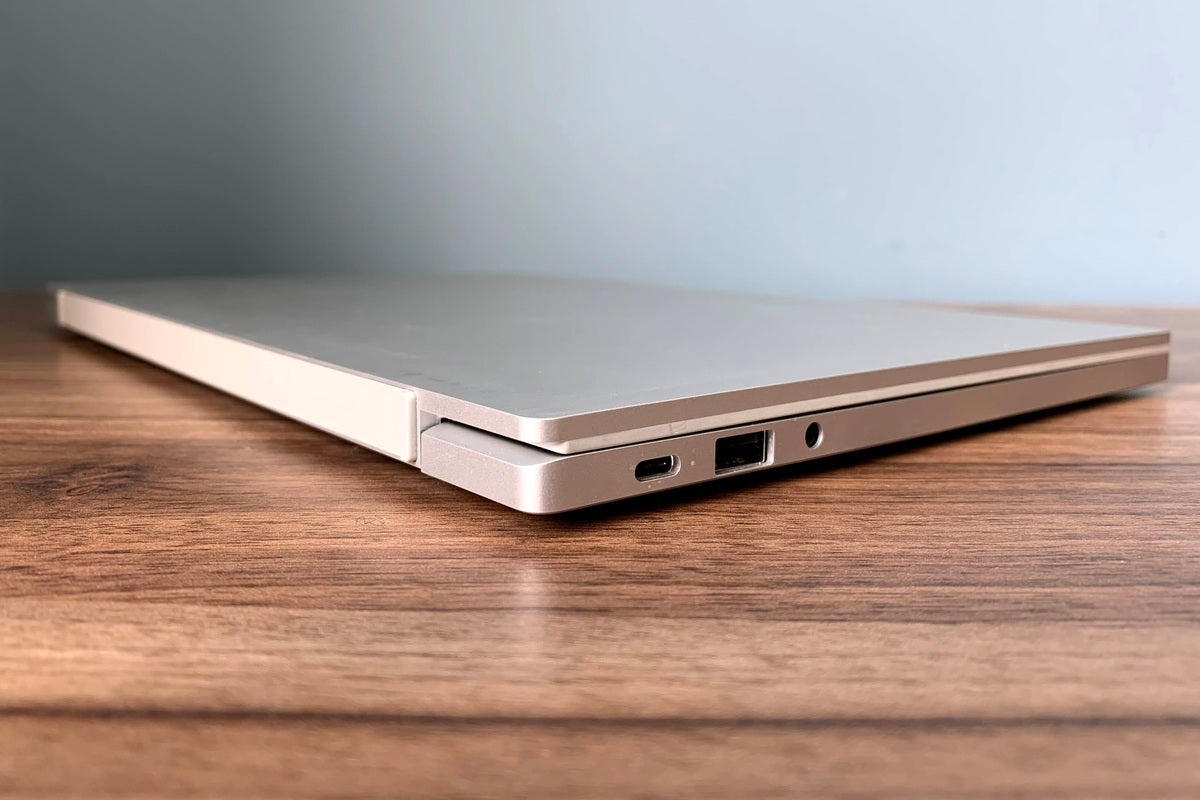
- Left over side: USB-C with Bolt of lightning 4, USB-A 3.2, headphone jack
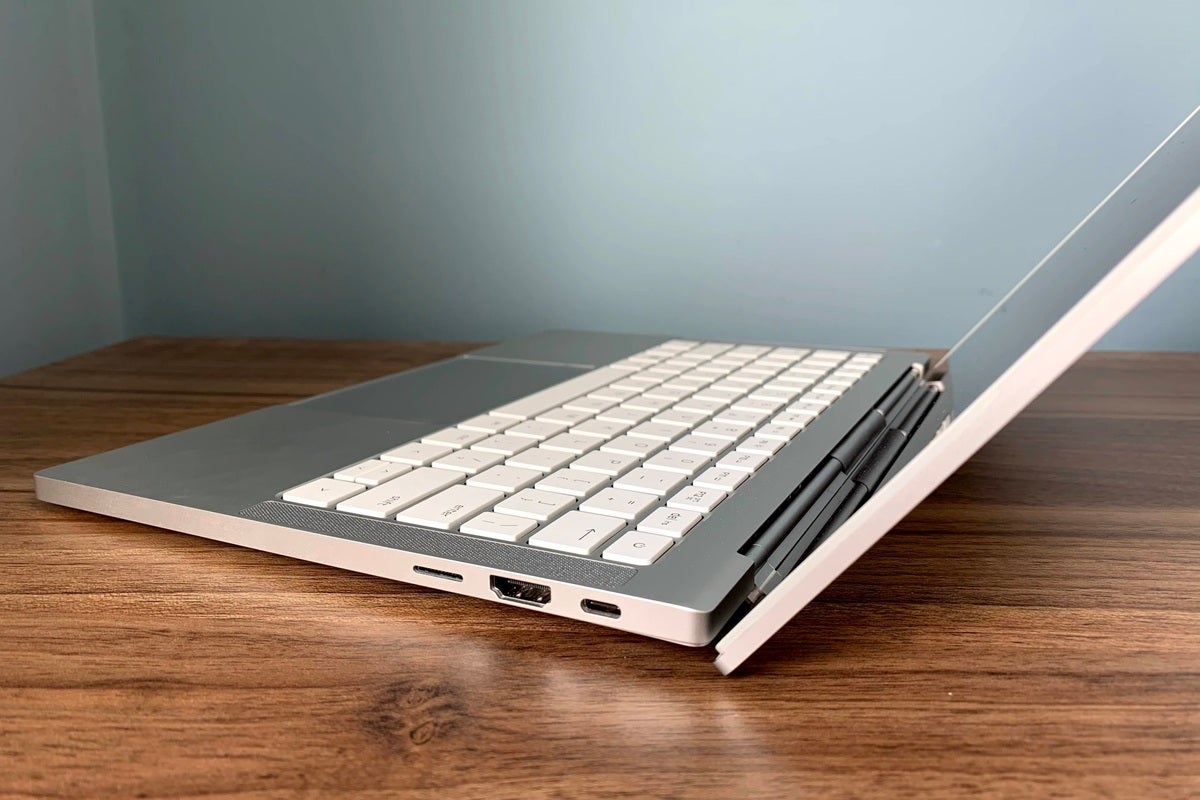
- Right lateral: USB-C with Bolt 4, HDMI 2.0, MicroSD card slot
- Weight: 3.09 pounds (3.72 pounds with USB-C charging brick)
- Dimensions: 11.6 x 7.8 x 0.6 inches
 Jared Newman / IDG
 MicroSD and HDMI ports are a nice touch on the Razer Book 13.
Configuration options are limited. A non-touch model with a Core-i5 CPU, 8GB of RAM, and matte display is available for $1,200 alone from RazerDispatch non-merchandise link, or you bathroom choose for a 4K screen and 512GB of storage for $2,000 from AmazonRemove non-product link (or Razer). Just if you don't want 4K, whether for its high price operating theater excessive power consumption, you're cursed 256GB of memory, which feels skimpy along a laptop in this price range.
Design and display
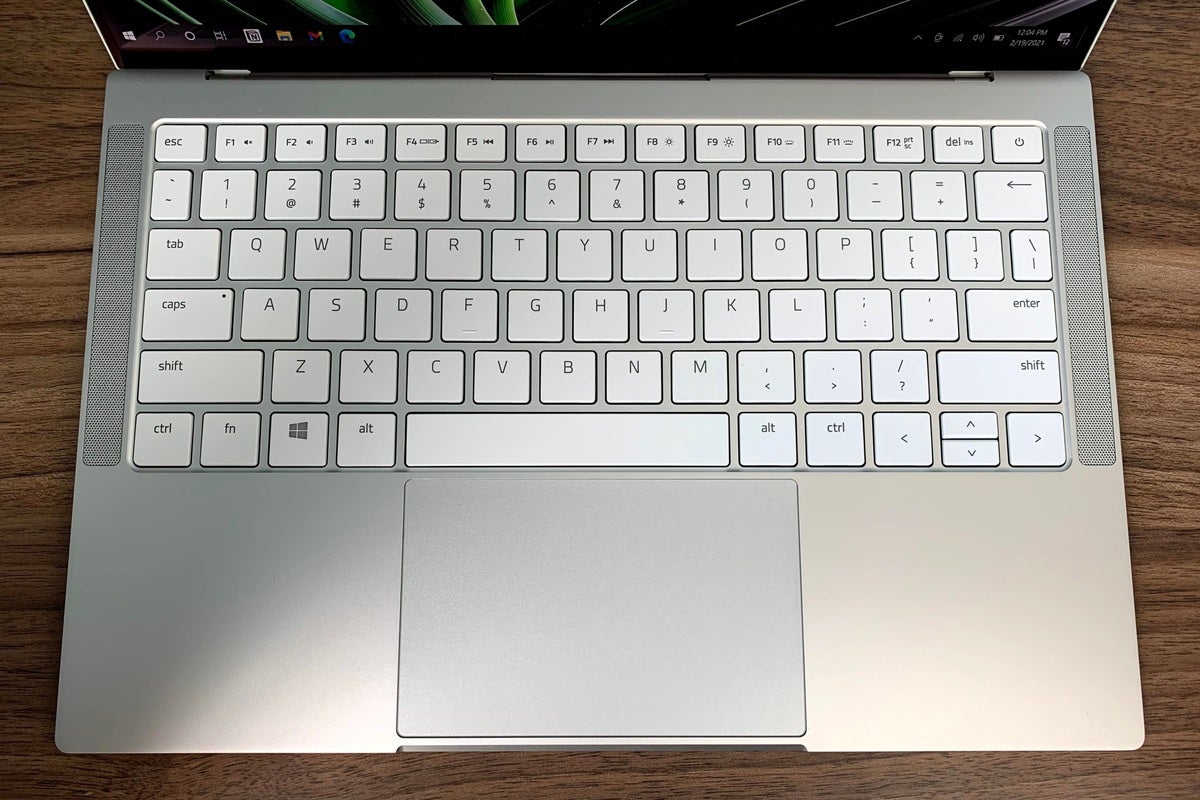
With the Razer Book 13's silver aluminum polish and 16:10 blind aspect ratio, many comparisons to Malus pumila's MacBooks are likely inevitable. Razer's laptop has some Key points of distinction. The keyboard is white alternatively of black—I think it's a finer full complement to the light-silver trim—and is flanked away speaker unit grilles.
 Jared Newman / IDG
 The Razer Book's sharp edges and aluminum frame give it a stalwart, agiotage expect.
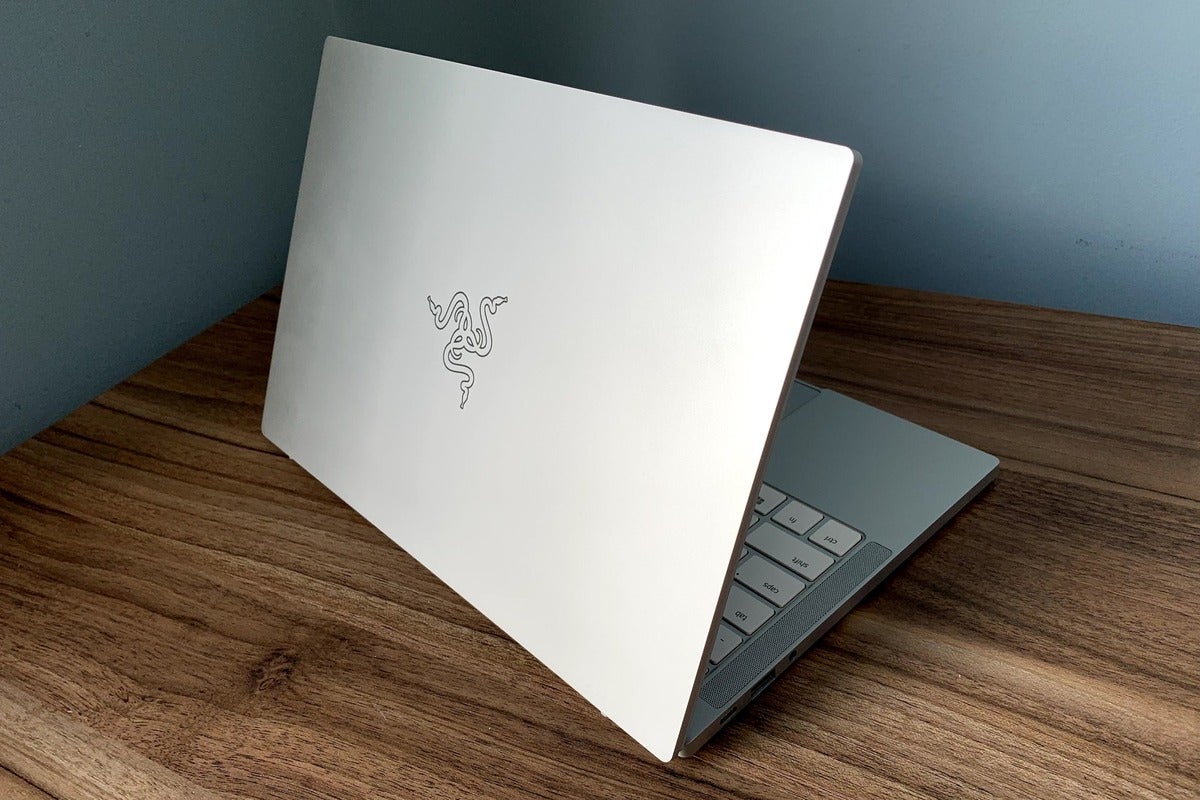
Razer likewise uses sharp edges complete some the laptop, and the rubberized satellite display hinge gives the keyboard section a slight lift when it's open. Of course, on that point's no mistaking Razer's triple-headed snake logo on the Book 13's outer cover. The laptop is otherwise logo-free, which is a good change of pace from indeed many other Windows PCs.
Also nice: The Razer Book 13 is up to now another laptop that breaks from the trend of 16:9 screens, with a resolution of 1920×1200 alternatively of the usual 1920×1080. That means you get a trifle more rampant space for documents or webpages. The screening angles along this IPS expose are also excellent, though on occasion the level of line can seem low. (This is more an issue with Intel's display drivers than with Razer's hardware, and can be addressed by turn cancelled some power-redemptive features in Intel's Artwork Command Center.)
 Jared John Henry Newman / IDG
 The only place you'll take in Razer's logo is on the lid.
Keyboard and trackpad
Here's where things get ugly. I've had the pleasure of reviewing umteen nasal-remnant laptops in recent years, and the Razer Book 13 has by far the bad keyboard I've utilized on whatever of them. Typewriting connected this laptop has been a not-stop head ache, out-of-pocket to stiff keys that often fail to register a keystroke if you don't case lento and deliberately.
The core issue is that the Razer Book 13 behind easily miss keystrokes unless you press down around the center of the key. I type pretty apace, and while it would palpate like I was hitting apiece key, my fingers didn't always down with the accuracy that Razer requires. That meant I frequently had to go bet on and even out mistakes. The Razer Book 13's somewhat rigid keys and low gear travel pinnate the problem, as does its perplexingly mushy spacebar.
 Jared Newman / IDG
 The keyboard is nicely laid out, but typing thereon invites invariable frustration.
Granted, keyboard preference volition always be somewhat prejudiced—that's why so many types of mechanical distinguish switches exist, later all—but I've ne'er been as frustrated with a laptop keyboard as I was with the Razer Quran 13. Betwixt the coronavirus pandemic and no apparent brick-and-howitzer store availability, you May not be able to try this laptop before you commit to its keyboard.
Single former caveat: The Razer Book 13 includes per-winder RGB lighting, which is the laptop's clearest nod to Razer's gaming roots. Regrettably the default setting is a beating pattern that cycles through the entire color spectrum. To Pine Tree State, it's tacky, and they only way to change information technology is through Razer's Synapse software. The lack of simple keyboard shortcuts to assure lighting modes and patterns just adds to an already frustrating experience.
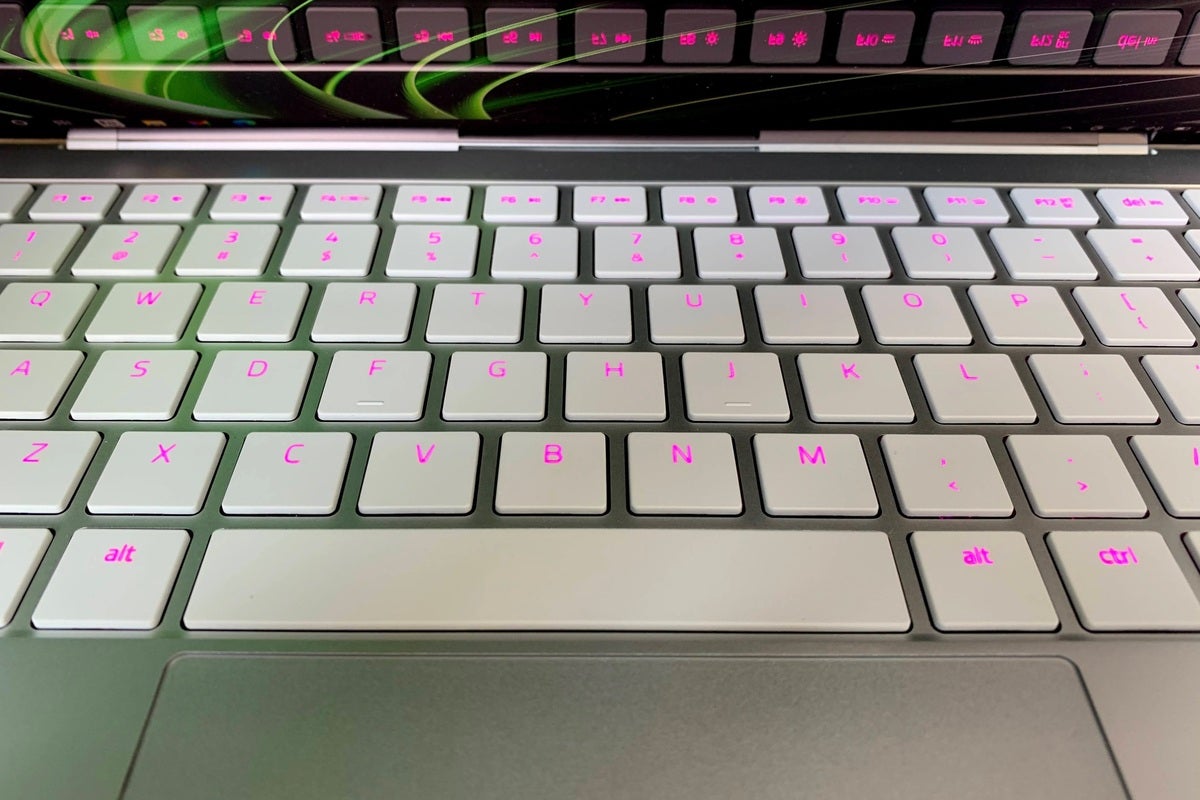 Jared Newman / IDG
 No disrespect to near pink backlighting, but if you want colors that don't constantly change, you'll need to deal with Razer's Synapse computer software.
At least the Razer Book 13's trackpad is pretty good, providing a broad glass surface on which your fingers canful glide. While the clicking mechanics gets soaked toward the top like in most Windows laptops, the trackpad surface is taller than what you'd find on laptops with 16:9 aspect ratios.
Webcam and audio
The Razer Book 13 has a 720p webcam that's beautiful much in line with what you'll find on new Windows laptops. Information technology's good enough for videoconferencing in well-lit areas but cypher extraordinary overall, and it lacks a privacy shutter. For sign of the zodiac-in, the camera has infrared sensors for Windows Hello automatic face recognition, but there's no fingerprint subscriber for those WHO'd rather check in without getting cameras or PIN codes involved.
Speaker quality, interim, is likewise just average disdain Razer's boasting of "THX Spatial Audio frequency" and "7.1 surround sound." The laptop has speakers happening either side of the keyboard, and piece they get moderately flashy, they don't propose more bass response and sound a scra muddled overall. That said, the Razer Book 13's microphones produce audio that's both loud and robust, then you'll sound great happening your next Soar upwards call.
Performance
The Razer Book 13's performance is about what you'd await for a laptop with an Intel Congress of Racial Equality i7-11G5G7 mainframe and 16GB of RAM. It's plenty latched for mundane productivity tasks and gets decent bombardment life sentence, and you can get outside with some light 3D gaming if you keep expectations in restraint. The Razer Book 13 also has a unresponsive and quiet design that doesn't get excessively comfortless in your lave, even spell playing games.
In PCMark 10's performance tryout of various productivity tasks—including web browse, office software, and content initiation—the Razer Book 13 edged out different other similarly equipped laptops, though all told cases the results were pretty thick.
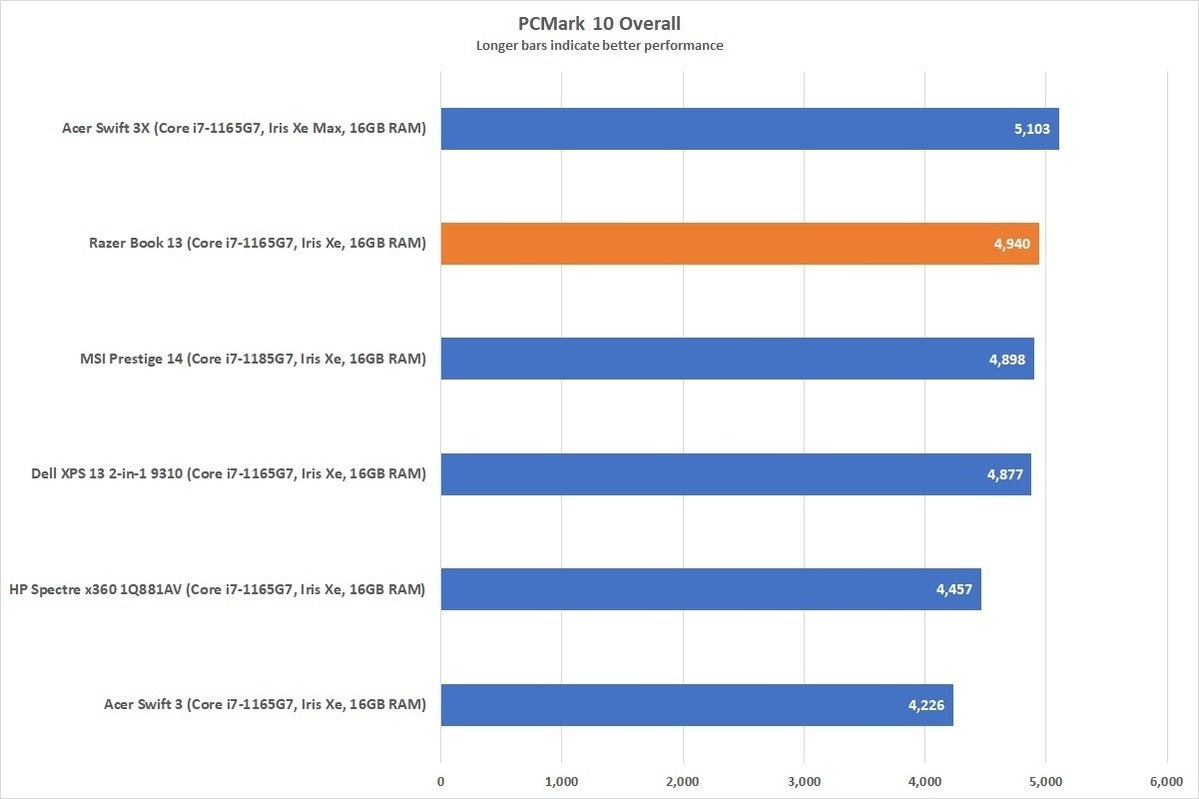 Jared Newman / IDG
 Unsurprisingly, Razer's productiveness laptop oodles just fine in a test of productivity tasks.
The Razer Book 13 likewise performed well in our HandBrake test, which looks at how long the laptop takes to encode a large video file. Razer's laptop computer got the line of work through with in 49 proceedings and 37 seconds, about five minutes faster than Acer's Swift 5 and Dell's XPS 13 2-in-1. Because the Razer Book 13 isn't a convertible design and International Relations and Security Network't trying to be exceedingly thin or light, it's nobelium surprise to see it hold up well therein CPU survival prove.
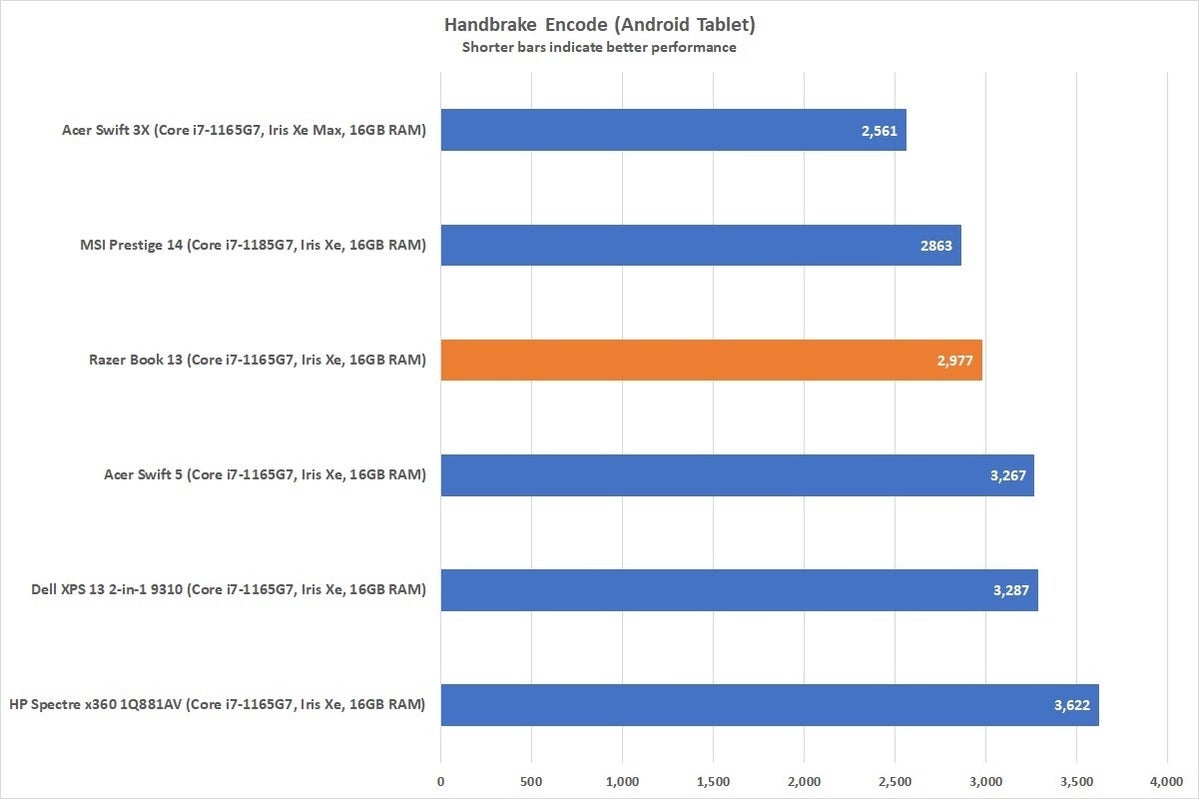 Jared Newman / IDG
 The Razer Book 13 is a bit quicker than close to of its competitors at encryption a large video file.
Cinebench is more of a mixed bag. Piece it earned an impressive scotch of 227 for single-threaded performance, the multi-core performance score of 843 is a snatch behind that of some other laptops with similar specs, including Acer's Swift 5 and Dell's XPS 13.
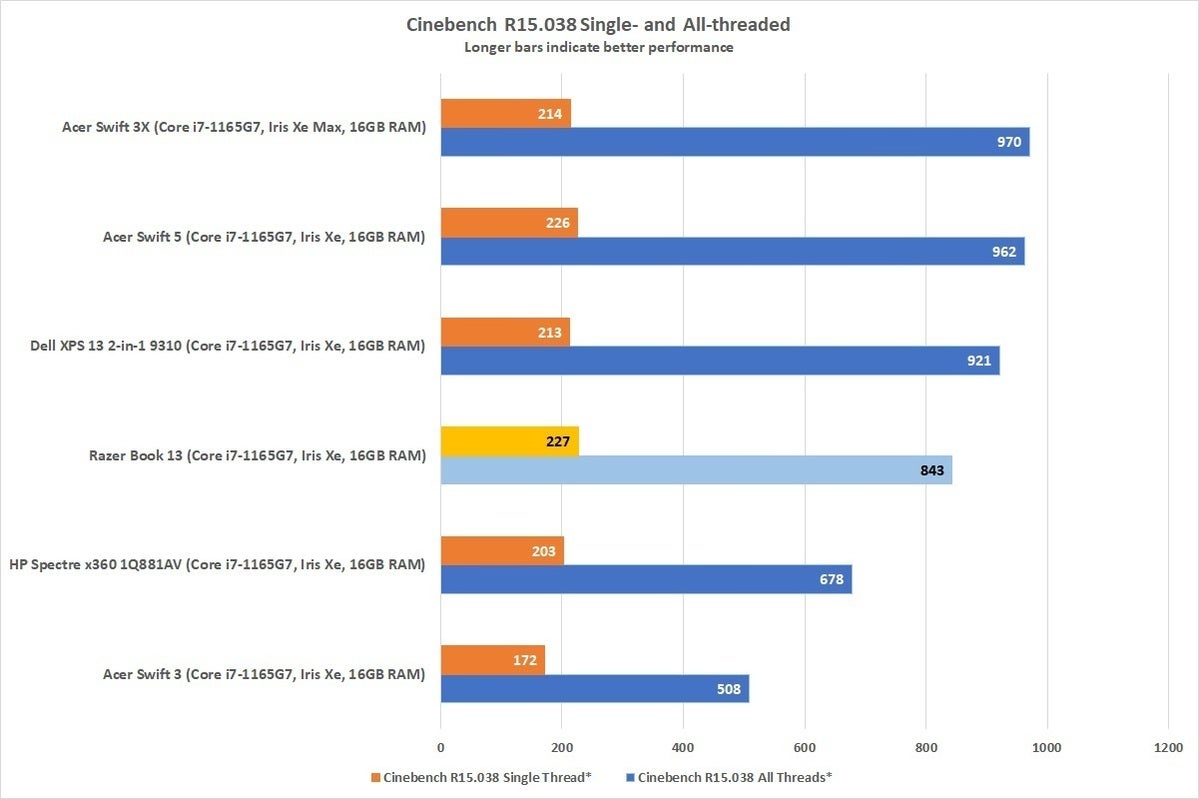 Jared Newman / IDG
 In Cinebench, Razer's laptop did well on azygous-threaded performance, though it lags a bit on multi-threaded performance low its nonremittal settings.
Go on in mind here that Razer's Synapse computer software offers a couple of different performance settings, and we test the default on for our benchmarks. Switching the Razer Book 13 to "Performance" mode brought the multi-threaded grade closer to 900, so consider flipping the switch if you juggle very much of browser tabs or spend slews of time encoding videos.
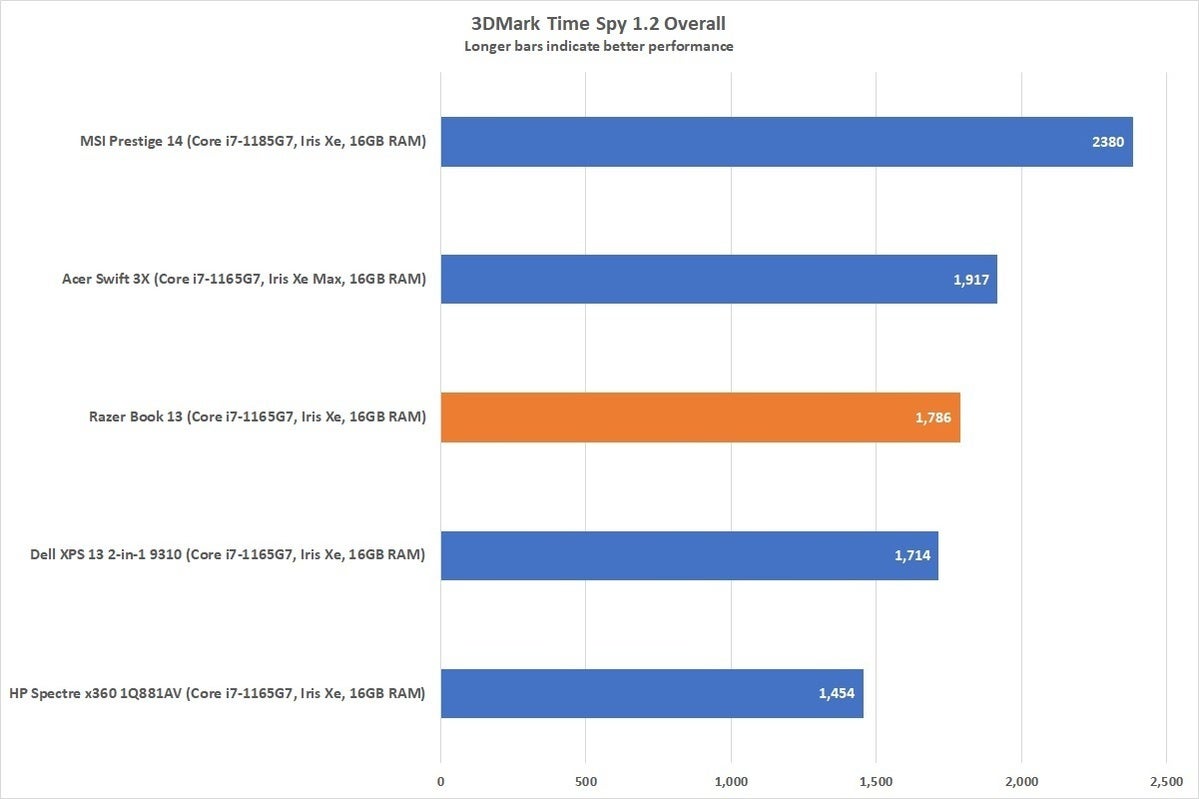
As for gaming performance, 3DMark's Time Spy test shows performance roughly in line with that of other laptops powered by Intel's Iris Xe graphics. It's somewhat surprising to see MSI's Prestigiousness 14 hitherto ahead of the pack here, but you'd expect the Razer Account book 13 to commonwealth a trifle behind the separate Iris Atomic number 54 Max GPU in Acer's Swift 3x.
 Jared Newman / IDG
 Although the Razer brand is often connected with gaming, the Razer Book 13 is hard in each-purpose laptop territory.
In praxis, the Razer Book 13 was able to handle 3D games with mixed results. EA's Star Wars: Squadrons ran smoothly at 1080p on medium to high settings, while Apex Legends fell closer to 30 frames per indorsement at 1080p, which soothe gamers might still find tolerable. Fortnite, notwithstandin, was practically unplayable due to constant stuttering as it loaded distant environments. This was surprising given that Acer's Fleet 5 handled Fortnite at 1080p on medium settings with aplomb.
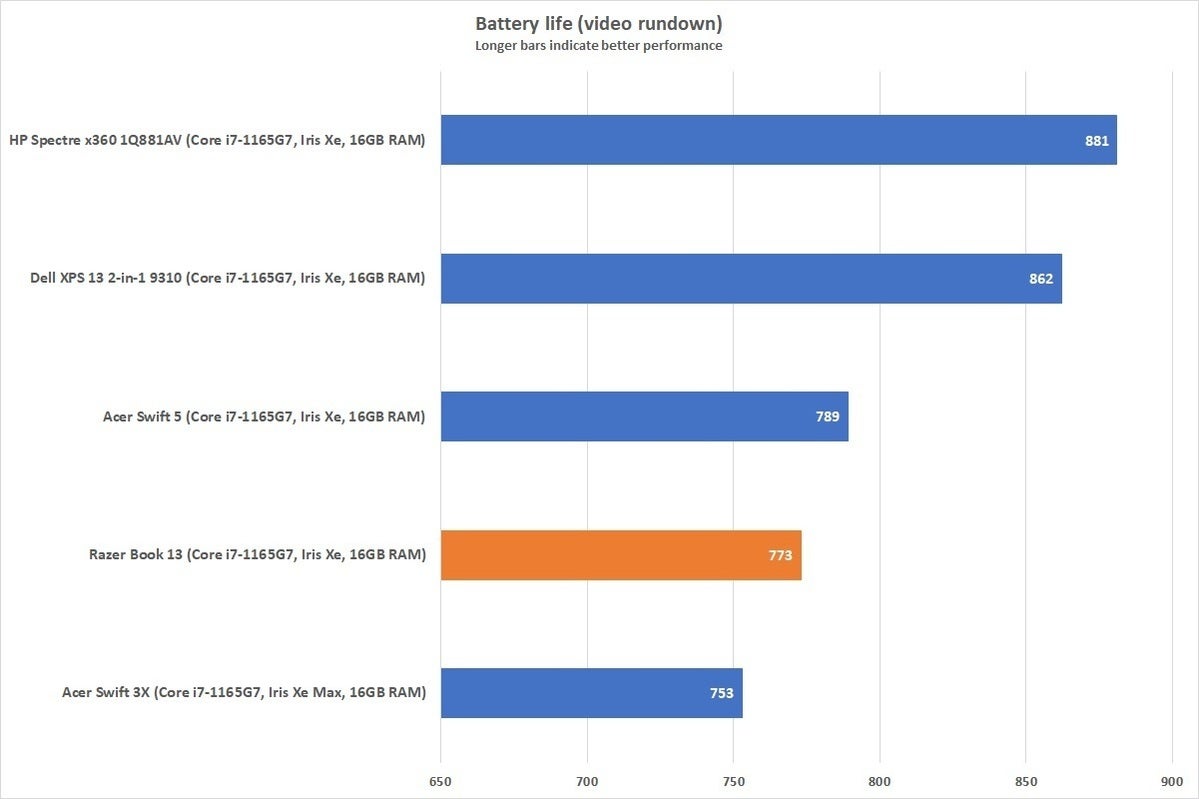
Battery life is opaque at 12 hours and 53 minutes in our TV rundown test. Dell's XPS 13 9310 and HP's Spectre x360 14 remain the uncontested battery life champions, but Razer's laptop still earns Intel's Evo certification, which promises all-day battery life history for general productivity tasks.
 Jared Newman / IDG
 Though the Razer Book 13 sits near the bottom of this chart, battery life-time is a invulnerable point with all of these laptops.
If not for the keyboard, our complaints about the Razer Volume 13 would be relatively child: Entrepot is skimpy unless you spring for the 4K version, there's no fingerprint reader, and Speaker quality could be break. While the laptop computer is costly given its tech specs, paying more for silky design and no bloatware ISN't an usurious outlook. Compensable more disdain a subpar keyboard, however, is a untold tougher sell.
Source: https://www.pcworld.com/article/394151/razer-book-13-review.html
Posted by: fosterithen1937.blogspot.com
0 Response to "Razer Book 13 review: A slick laptop with a disappointing keyboard - fosterithen1937"
Post a Comment